
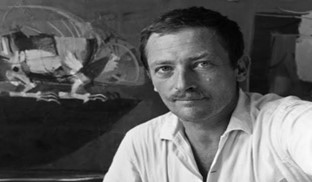
Alejandro Obregón (1920–1992) was one of Colombia’s most celebrated modern painters, known for merging Abstract Expressionism with national identity. Born on June 4, 1920, in Barcelona to a Colombian father and a Catalan mother, he grew up between Spain and Colombia, a bicultural upbringing that shaped his vision. In 1939, with the outbreak of the Spanish Civil War, his family returned to Colombia. Obregón pursued studies in Boston but soon discovered that his true path lay in painting. By the 1940s, he was already experimenting with Cubism and Surrealism, influenced by European modernists such as Pablo Picasso and Georges Braque. His first solo exhibition in Barranquilla introduced him as a bold new voice in Colombian art, with works distinguished by vivid colors, energetic brushwork, and a fascination with abstraction.
Throughout the 1950s, his style developed into a personal synthesis of abstraction and figuration, often depicting animals such as bulls, birds, and marine creatures as symbols of struggle, violence, and the forces of nature. His international breakthrough came in 1955 when he represented Colombia at the São Paulo Biennial, earning critical acclaim for his originality. A pivotal moment in his career arrived with the creation of the “Violencia” series in the late 1950s, a searing artistic response to Colombia’s brutal civil conflict. These works, defined by their powerful use of color and form, captured the anguish of a nation and established Obregón as an artist who combined aesthetic innovation with social commentary. In 1962, he received Colombia’s National Prize for Painting, solidifying his place as a leading figure in Latin American art.
During the 1970s, Obregón began working on larger canvases and monumental murals in Bogotá and Barranquilla, bringing his art into public spaces. One of his most enduring symbols was the condor, a bird representing freedom and resilience in Andean culture, which became a recurring motif in his paintings. Works such as El Cóndor and Vuelo del Cóndor embody his fusion of national identity with expressive modernism. Despite challenges in his personal and political life, he continued to explore new approaches to color and form. His marriages to poet Sonia Osorio and later to painter Freda Sargent were both sources of creative dialogue and inspiration.
In 1985, Obregón was awarded the Order of San Carlos, one of Colombia’s highest honors, in recognition of his role as a cultural ambassador. Even in his later years, he remained active as an artist and mentor, inspiring younger generations. He died on April 1, 1992, in Cartagena, leaving behind a powerful legacy. Today his works are housed in major collections such as the Museo Nacional de Colombia and the Museo de Arte Moderno de Bogotá. Obregón is remembered as a bold visionary whose art reflected both the turmoil and the vitality of Colombia, merging modernist techniques with the spirit of his homeland.
