
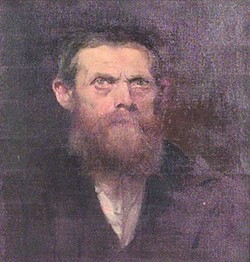
Eugene de Blaas (1843-1932), also known as Eugen von Blaas, was one of the foremost painters of Venetian genre scenes, celebrated for his exquisite depictions of everyday life in 19th- and early 20th-century Venice. Born in Albano Laziale near Rome into an artistic family—his father, Karl von Blaas, was a renowned Austrian history painter and professor—Eugene was immersed in art from a young age, receiving rigorous training in drawing, composition, and color theory. His family’s move to Venice during his adolescence exposed him to the city’s rich visual heritage, which would profoundly shape his aesthetic sensibilities and lifelong fascination with Venetian culture and architecture.
De Blaas honed his skills at the Academy of Fine Arts in Venice, refining a style that blended academic realism with romantic idealism, marked by meticulous attention to light, texture, and color. By the 1860s, he began exhibiting his works, gaining recognition for vibrant portraits and genre scenes that celebrated Venetian life, particularly women such as fisherwomen, flower sellers, and aristocratic ladies. Paintings like The Flirtation and The Water Carrier exemplify his ability to capture both narrative and emotion, conveying subtle gestures, expressions, and social interactions with remarkable clarity and warmth.
Throughout his career, de Blaas remained dedicated to capturing the elegance, charm, and vitality of Venice, often setting his figures against the city’s iconic canals, palaces, and narrow alleys. His work elevated genre painting, infusing scenes of daily life with dignity, narrative depth, and psychological insight, while his luminous handling of color and fine attention to detail set his paintings apart from contemporaries. By the 1870s, his reputation had expanded internationally, with exhibitions in Vienna, Munich, and London, and commissions from European nobility, cementing his status as a leading figure in academic painting.
Even as modernist movements gained prominence in the early 20th century, de Blaas continued to produce works in his signature style, maintaining its charm, technical brilliance, and emotional resonance. Later paintings such as At the Well and The Serenade showcase his enduring fascination with human form, social subtleties, and the beauty of everyday moments. In addition to his artistic practice, he served as a teacher at the Venetian Academy, mentoring the next generation of painters and ensuring the continuation of academic traditions.
Eugene de Blaas passed away on February 10, 1932, in Venice, leaving behind a body of work that continues to captivate audiences for its technical mastery, elegance, and celebration of Venetian life. His legacy endures as a testament to the power of art to transform ordinary experiences into narratives of humanity, emotion, and timeless beauty.
