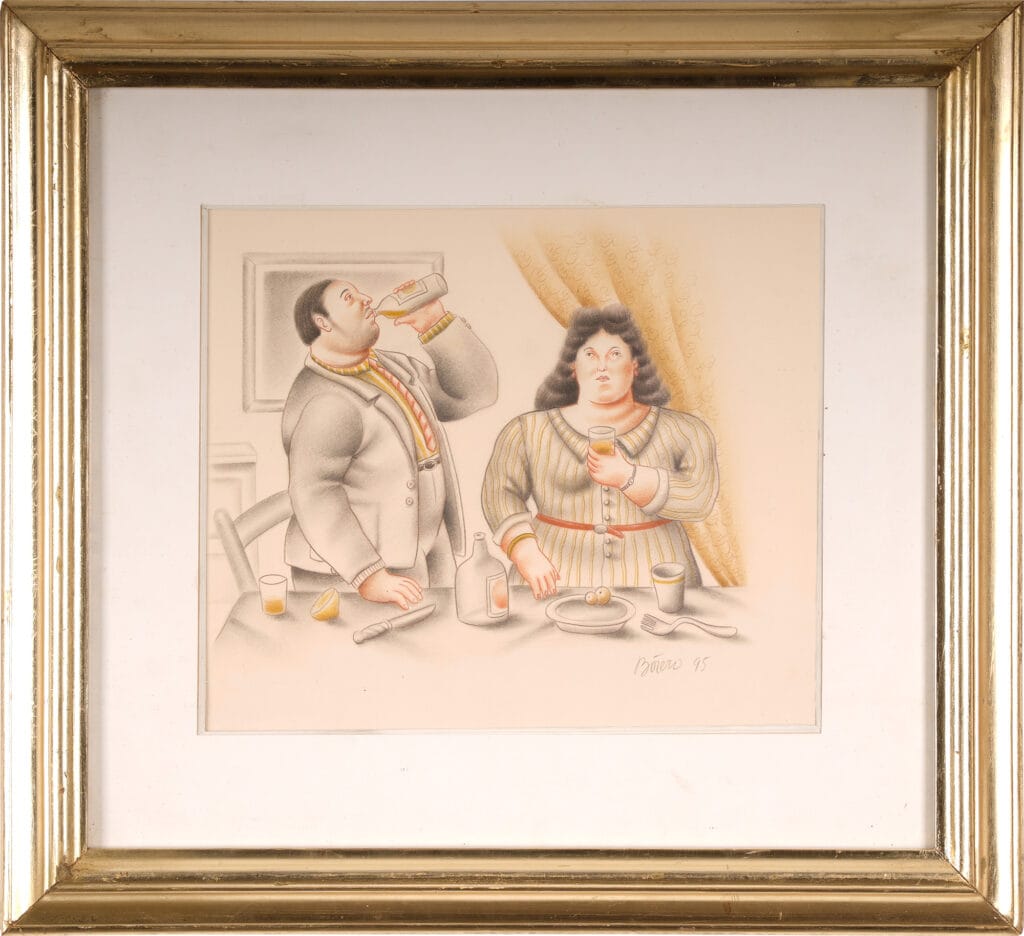
Fernando Botero is one of the most recognizable artists of the 20th and 21st centuries, celebrated for his exaggerated proportions, bold colors, and unique technique that highlights fullness and volume. His distinctive style, later known as “Boterismo,” offered both humor and poignant commentary, inviting viewers to reflect on culture, politics, and societal norms through a playful yet critical lens.
Early Life and Education
Fernando Botero was born on April 19, 1932, in Medellín, Colombia. His father, David Botero, was a traveling salesman, and his mother, Flora Angulo, worked as a seamstress. Botero’s childhood was shaped by tragedy when his father passed away at the age of four.
From a young age, Botero showed artistic promise. Inspired by bullfighting, he created drawings for a local newspaper as a teenager. At just sixteen, in 1948, he held his first exhibition in Medellín. Although largely self-taught, Botero later pursued formal studies at the Academia de San Fernando in Madrid and the Academy of San Marco in Florence, where he immersed himself in classical art traditions.
Development of Boterismo
During the 1950s, Botero began shaping his unique artistic voice. His exaggerated, voluminous forms challenged conventional ideals of beauty and proportion. This bold approach became his hallmark, defining both his paintings and sculptures. His works often depicted plump, rounded figures—men, women, animals, and still lifes—infused with satire, humor, and social commentary.
Botero’s breakthrough came in the early 1960s when he exhibited in New York. His playful yet thought-provoking style attracted global attention, positioning him as a bridge between Latin American art and the international art scene.
International Success
Throughout the 1960s and 1970s, Botero’s art evolved, increasingly incorporating political and social themes, particularly critiques of injustice and corruption in Colombia. His sculptures became as iconic as his paintings, often installed in public spaces in cities such as New York, Paris, and Medellín.
In 1973, Botero moved to Paris and devoted much of his energy to monumental sculpture. His large bronze works—depicting corpulent men, women, and animals—transformed urban landscapes, simultaneously playful and profound, encouraging viewers to question cultural norms.
Notable Works and Themes
Among his most impactful projects was “The Abu Ghraib Series” (2004), created in response to the abuse of prisoners in Iraq. Using his signature style, Botero conveyed the horrors of torture and war crimes, demonstrating his ability to confront weighty issues through art.
Botero’s paintings and sculptures spanned diverse themes: portraits, still lifes, nudes, and depictions of Latin American life. His art consistently explored power, sensuality, politics, and humanity, blending satire with compassion.
Personal Life
Botero’s life was marked by both triumph and tragedy. In 1974, he suffered the devastating loss of his four-year-old son, Pedrito, in a car accident in Spain. Deeply affected, he memorialized his son in a series of poignant works, expressing his grief through art.
Despite international fame, Botero remained closely tied to Colombia. He generously donated works to museums in Bogotá and Medellín, helping establish major cultural institutions and securing his place as a national treasure.
Legacy
Over a career spanning more than seven decades, Fernando Botero created a vast body of work that continues to captivate audiences worldwide. His art, housed in major museums and displayed in public spaces across continents, is celebrated for its originality, boldness, and humanity.
Botero passed away in 2023, leaving behind a powerful legacy. Known as one of the greatest Latin American artists of his time, his unique vision and unmistakable style continue to inspire reflection and admiration across generations.