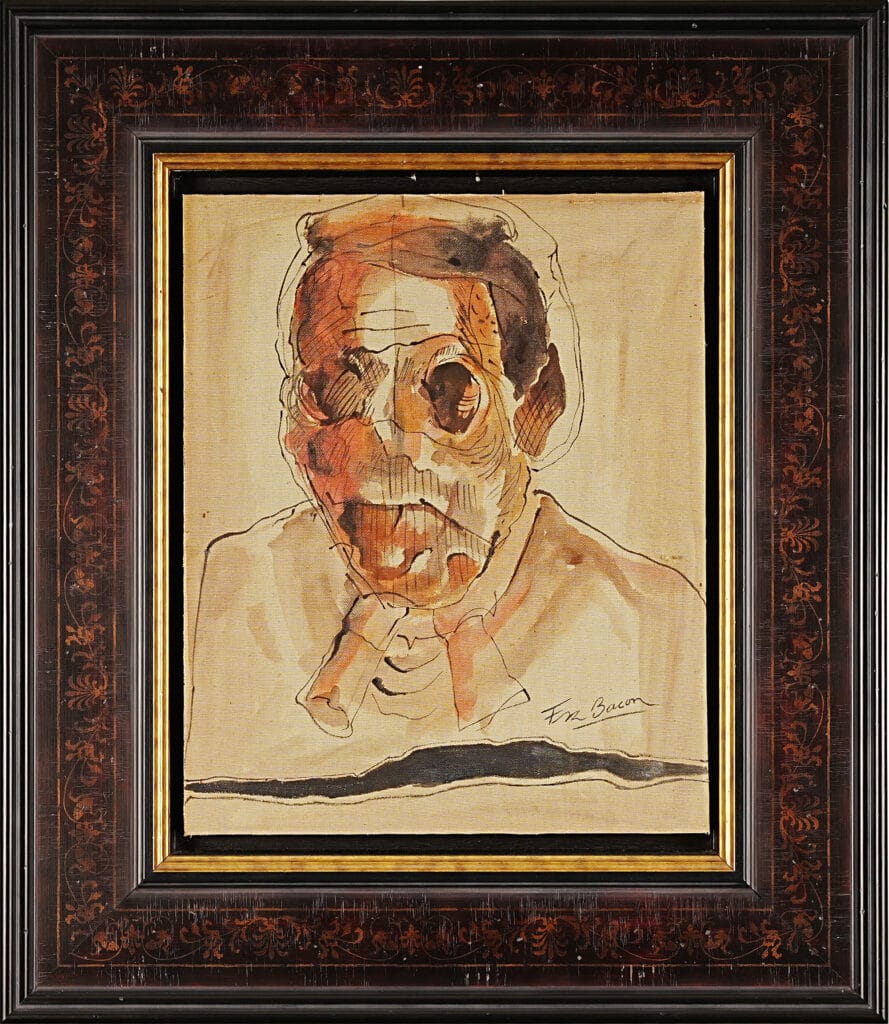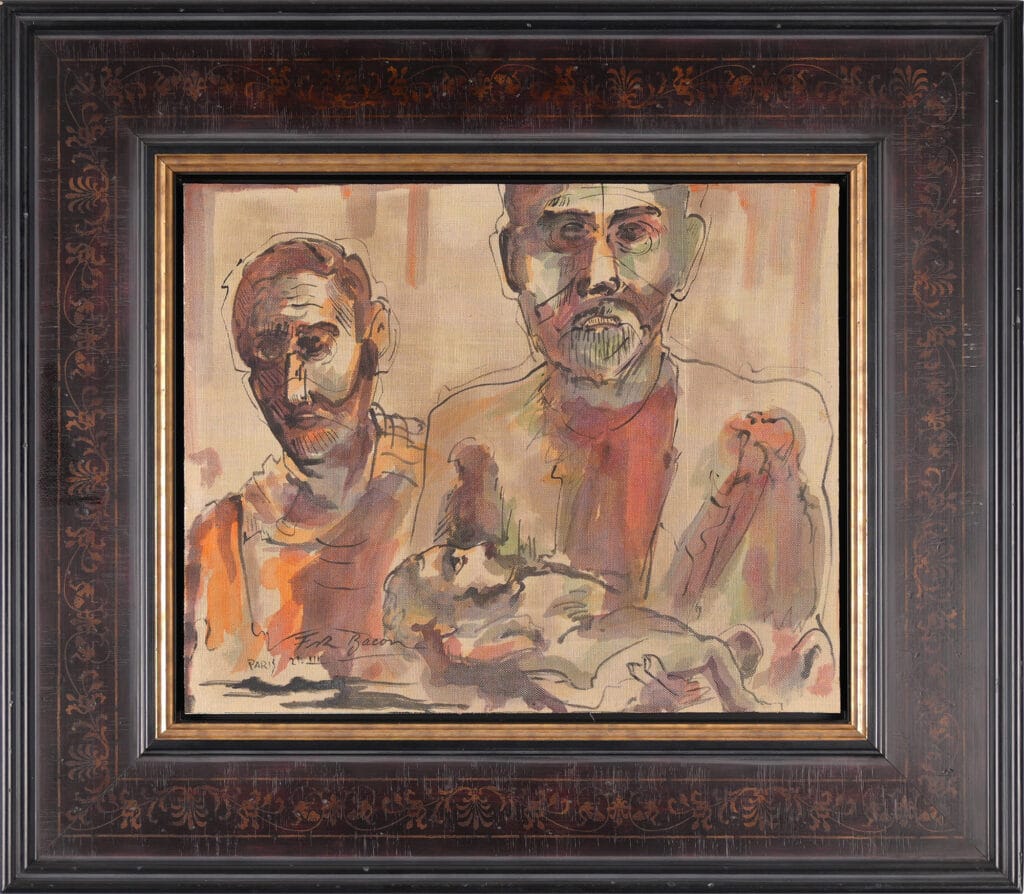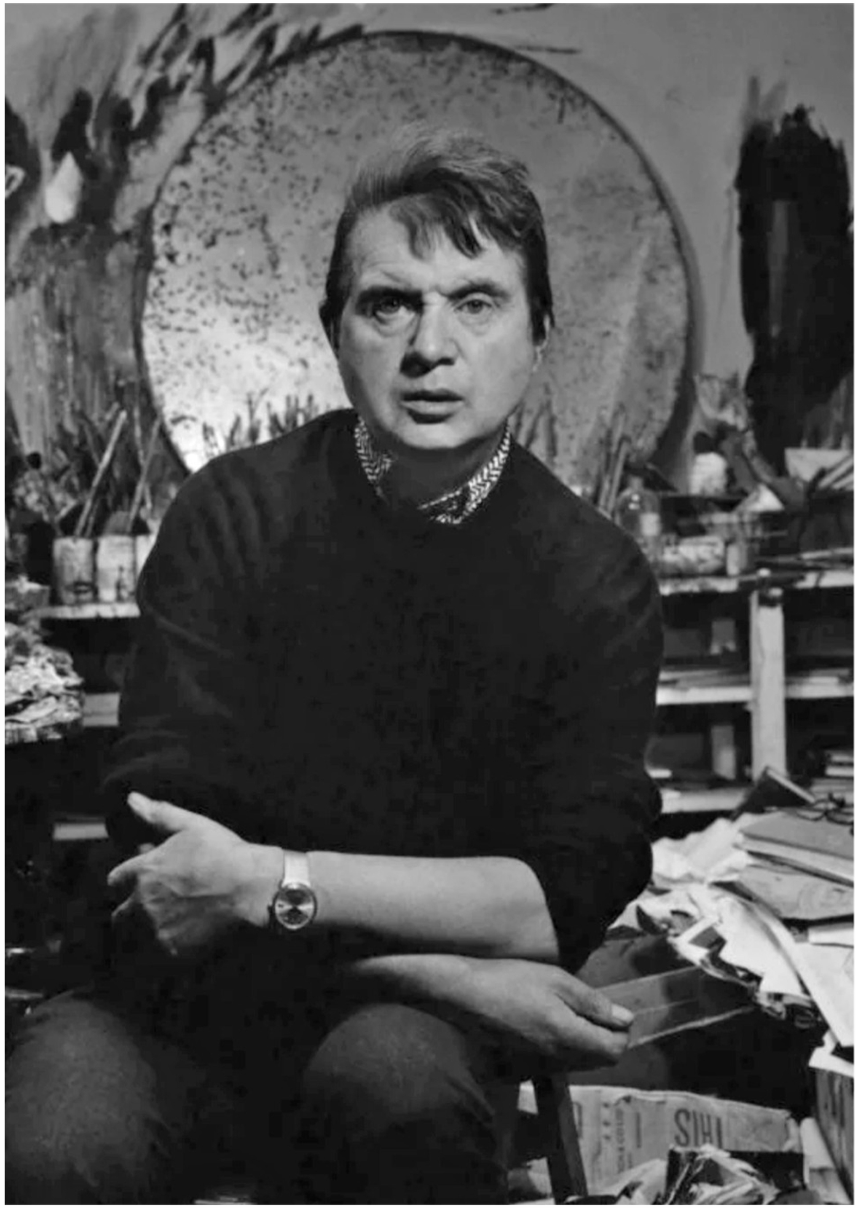
Francis Bacon was born on October 28, 1909, in Dublin, Ireland, into a British family. His early years were turbulent, marked by family tensions and asthma. A strained relationship with his father led to Bacon being expelled from the family home at a young age, fostering a sense of isolation that would later influence his art.
Early Career and Influences
In the late 1920s, Bacon moved to London and traveled to Berlin and Paris, immersing himself in European modernist movements. He was influenced by Picasso, Surrealism, and the avant-garde. Initially working in interior decoration and furniture design, he gradually shifted focus to painting, experimenting with biomorphic and abstract forms in the early 1930s.
Breakthrough: Three Studies for Figures at the Base of a Crucifixion
Bacon’s breakthrough came in 1944 with Three Studies for Figures at the Base of a Crucifixion, a triptych depicting twisted and distorted forms. This work marked a dramatic shift in post-war British art, exploring the horrors of war and existential anguish.
Signature Style
In the post-war years, Bacon developed his iconic style: figures in stark, claustrophobic spaces, with raw brushstrokes and visceral distortion. His work often featured contorted bodies, open mouths, and themes of violence, isolation, and mortality. Photography, especially Eadweard Muybridge, heavily influenced his study of motion and anatomy.
Major Themes and Works
The 1960s brought Bacon international fame. Iconic paintings of popes, inspired by Velázquez’s Portrait of Innocent X, and triptychs such as Three Studies of Lucian Freud (1969) exemplify his mastery of narrative across panels. His work explored power, suffering, desire, and human vulnerability with psychological intensity.
Personal Life
Bacon’s personal life was tumultuous. Openly gay in an era of discrimination, he had intense and sometimes destructive relationships. The suicide of his partner George Dyer in 1971 deeply affected him, inspiring the emotionally charged Black Triptychs. His chaotic studio in South Kensington reflected his instinctive and prolific creative process.
Later Years and Legacy
Bacon continued painting into the 1980s, evolving toward brighter colors and abstract backgrounds while maintaining themes of existential angst. He died on April 28, 1992, in Madrid. Today, he is recognized as one of the most significant British artists of the 20th century, with works in Tate Britain, MoMA, and Centre Pompidou. Bacon’s art remains celebrated for its raw intensity, psychological depth, and unflinching portrayal of the human condition.