
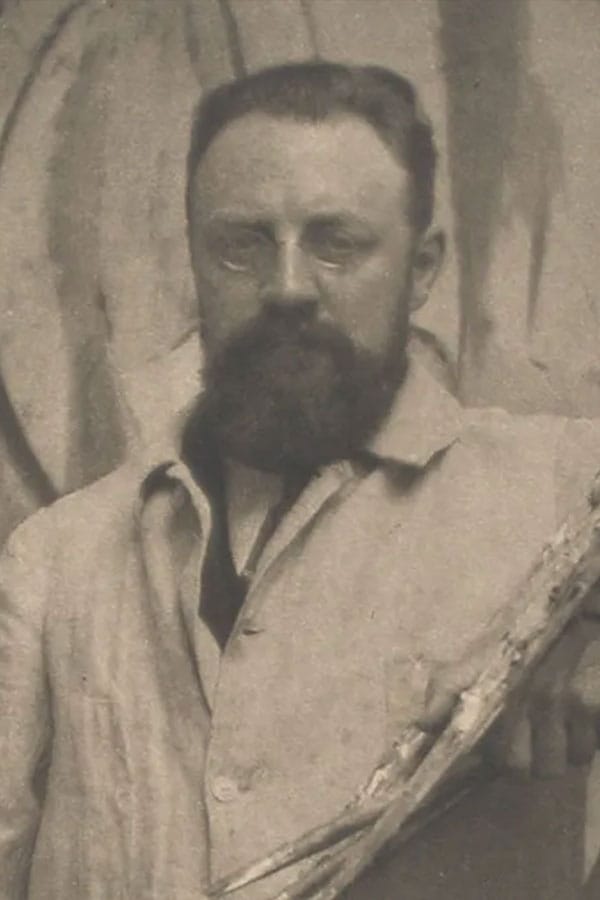
Henri Matisse (1869–1954) was a towering figure in 20th-century art, celebrated as a painter, printmaker, and sculptor whose innovative vision reshaped modernism. Born on December 31, 1869, in Le Cateau-Cambrésis, a small town in northern France, Matisse grew up in a middle-class family that ran a successful grain business. Initially, he was expected to follow in his father’s footsteps, pursuing a practical career in law. In 1887, he moved to Paris to study law and subsequently worked as a law clerk. However, at the age of twenty, while recovering from appendicitis, Matisse’s life changed dramatically. His mother brought him art supplies during his convalescence, and he discovered a profound passion for painting. Matisse later reflected on this moment, saying, “From the moment I held the box of colors in my hands, I knew this was my life.”
Following this revelation, Matisse abandoned law and in 1891 enrolled at the Académie Julian in Paris, one of the leading art institutions of the time. There, he studied under the guidance of Gustave Moreau, an established academic painter, who encouraged Matisse to experiment with form and color and to develop an independent artistic voice. Matisse’s early works were influenced by the academic tradition as well as the Impressionists, particularly Camille Pissarro and Claude Monet. Yet, he soon began to develop his own approach, focusing on bold colors, expressive brushwork, and innovative compositional strategies.
In the early 1900s, Matisse emerged as a central figure in the Fauvist movement, a group of artists known for their radical use of color and painterly freedom. His painting Woman with a Hat (1905) caused a scandal at the Salon d’Automne in Paris but firmly established him as a radical innovator. Fauvism represented a revolutionary approach to painting, prioritizing emotional expression over realistic representation. Works from this period, such as The Joy of Life (1906), exemplify Matisse’s ability to combine vibrant color with a sense of freedom, energy, and movement.
Matisse’s international travels profoundly influenced his art. Visits to Spain, Morocco, and Tahiti exposed him to bright color palettes, decorative motifs, and cultural patterns, which he integrated into his compositions. This led to a distinctive style characterized by flat planes of color, simplified forms, and rhythmic decorative patterns, exemplified in masterpieces such as Red Room (Harmony in Red) (1908) and The Dance (1910). His works during this period reflected a continuous exploration of visual harmony, balance, and the emotive potential of color.
In 1908, Matisse founded the Académie Matisse, an art school in Paris where he mentored young artists from around the world, fostering a new generation of modern painters and influencing the direction of contemporary art. Matisse’s oeuvre was not limited to painting; he was also a skilled sculptor and printmaker, demonstrating versatility across artistic media. His bronze etching matrices and other printmaking innovations revealed a meticulous engagement with materials, making the process itself a form of artistic expression.
Matisse’s personal life was intertwined with his art. He married Amélie Parayre in 1898, and they had three children. Though the marriage became strained later in life, Matisse remained dedicated to his work, constantly experimenting and evolving. In 1941, after undergoing surgery for cancer, he was largely bedridden, yet he invented his celebrated cut-out technique. This involved arranging painted paper shapes into dynamic, abstract compositions, resulting in iconic works such as The Snail (1953) and Blue Nude II (1952). This technique represents the culmination of Matisse’s lifelong investigation of color, form, and expressive potential.
During the 1940s and early 1950s, Matisse undertook one of his most personal projects: designing the Chapelle du Rosaire in Vence. He created not only the architectural layout but also the stained glass, murals, and decorative elements, integrating art and environment into a singular, spiritual experience. The chapel stands as a testament to Matisse’s mastery of color, space, and symbolism.
Henri Matisse died on November 3, 1954, in Nice, France, leaving behind a legacy of innovation, technical brilliance, and joy. His works are housed in major museums worldwide, including the Museum of Modern Art in New York and the Centre Pompidou in Paris. Matisse’s art continues to inspire generations with its bold use of color, expressive forms, and celebration of life. His journey from a law clerk to a master of modern art demonstrates his passion, resilience, and unwavering belief in the transformative power of creativity.
