
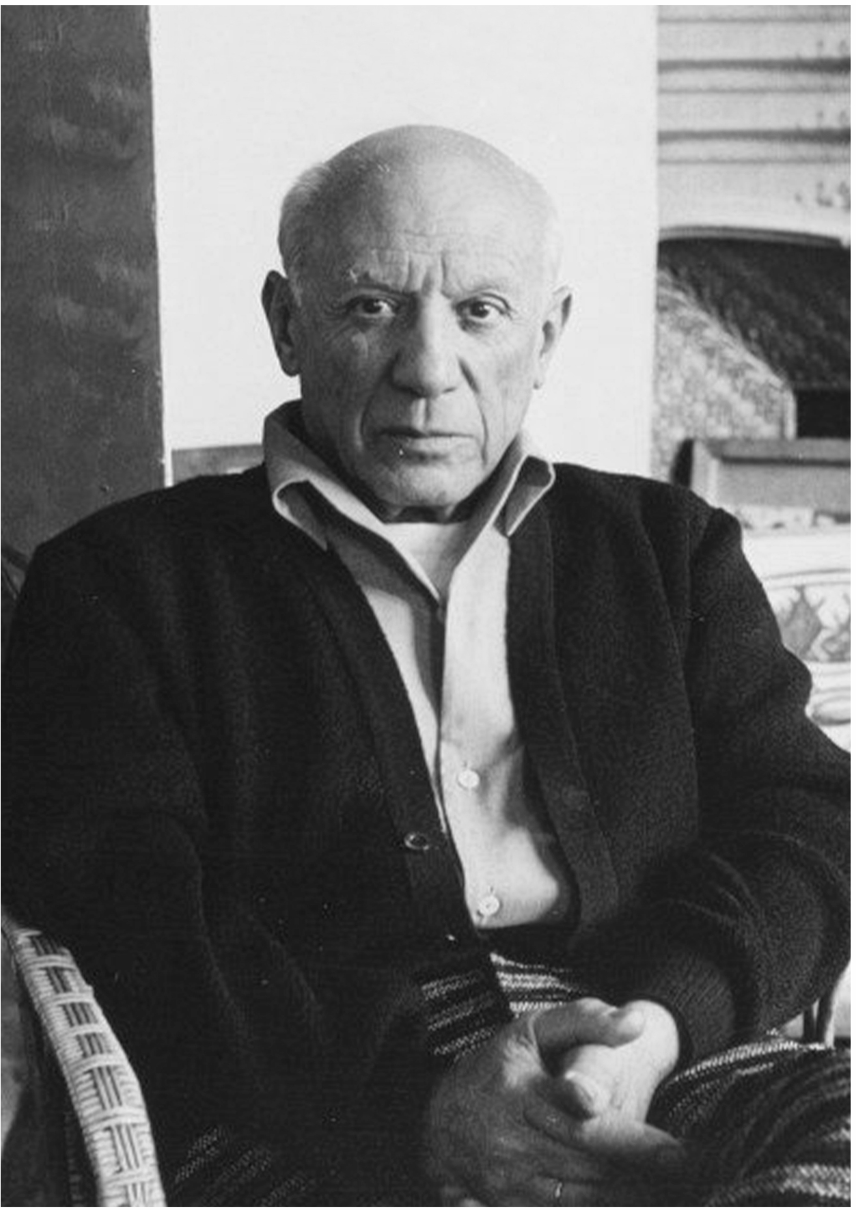
Pablo Picasso was born on October 25, 1881, in Málaga, Spain. His father, José Ruiz Blasco, was a painter and art teacher who trained him from a young age. By 13, Picasso had surpassed his father’s skill. He later studied at the School of Fine Arts in Barcelona and the Royal Academy of San Fernando in Madrid, though he was more influenced by studying Spanish masters like El Greco, Velázquez, and Goya at the Prado Museum than by formal instruction.
Blue and Rose Periods
In the early 1900s, Picasso’s style evolved through the Blue Period (1901–1904), characterized by melancholic themes and somber tones, followed by the Rose Period (1904–1907), featuring warmer colors and subjects such as circus performers and harlequins. These early periods reflect his emotional depth and experimental approach.
Cubism
In 1907, Picasso painted Les Demoiselles d’Avignon, a groundbreaking work inspired by African and Iberian art that broke traditional perspective rules. Together with Georges Braque, he developed Analytical Cubism, deconstructing objects into geometric shapes, and later Synthetic Cubism, incorporating collage and mixed media.
Later Styles and Surrealism
During World War I, Picasso explored neoclassicism, focusing on monumental and muscular figures. In the 1920s and 1930s, he engaged with the Surrealists, creating dreamlike and distorted compositions. His personal relationships, especially with women like Olga Khokhlova and Dora Maar, strongly influenced his work.
Guernica and Political Art
In 1937, Picasso responded to the bombing of Guernica during the Spanish Civil War with his monumental painting Guernica, a black-and-white anti-war masterpiece that became a universal symbol of human suffering and resistance. He also produced politically charged works after joining the Communist Party.
Personal Life
Picasso lived through turbulent historical times, including World War II, yet continued to create while in Nazi-occupied Paris. In later life, he settled in the South of France with Jacqueline Roque, who inspired many of his final works.
Legacy
Picasso died on April 8, 1973, leaving a vast body of work spanning painting, sculpture, ceramics, printmaking, and more. He is recognized as one of the most influential and innovative artists of the 20th century. His life story—from a precocious child in Málaga to a pioneer of modern art—reflects relentless experimentation, emotional depth, and a revolutionary spirit.
