
Description
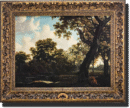
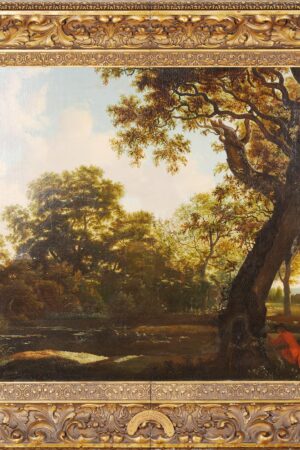
This artwork, attributed to Meindert Hobbema, presents a quintessential Jutland landscape: a tranquil rural scene under a vast sky. Rooted in the Dutch Golden Age, it reflects Hobbema’s attention to detail and masterful use of light. Luminous skies, winding paths, and tall trees guide the eye through the countryside. Subtle color shifts and intricate foliage showcase his deep grasp of nature’s rhythm, making this a fine 17th-century landscape.
Meindert Hobbema (1638–1709) was one of the finest landscape painters of the Dutch Golden Age. Renowned for his luminous depictions of the Dutch countryside, he brought an unparalleled sense of depth, light, and atmosphere to his work. Though underappreciated during his lifetime, his paintings later gained recognition as masterpieces of 17th-century landscape art, influencing generations of artists.
Born in Amsterdam, Hobbema was a pupil of the celebrated landscape painter Jacob van Ruisdael, whose dramatic skies and detailed forests greatly shaped his style. Like his mentor, Hobbema focused on rural scenes—capturing the beauty of trees, winding roads, watermills, and small villages. However, his work often displayed a brighter, more serene quality, emphasizing the harmony between nature and human life.
Hobbema’s landscapes stand out for their carefully structured compositions. He frequently used receding roads or canals to create depth and perspective, drawing the viewer into the scene. His celebrated painting The Avenue at Middelharnis (1689) demonstrates his mastery of perspective and naturalistic detail, making the viewer feel as if they could step directly into the tranquil Dutch countryside. His ability to capture light filtering through trees, reflecting on water, and casting soft shadows gave his works a lifelike vibrancy.
Despite his talent, Hobbema’s career was relatively short. In 1668, he accepted a position as a customs official in Amsterdam, which reduced the time he devoted to painting. Unlike many contemporaries, he did not achieve great wealth or fame during his lifetime, and after his death his work was largely forgotten. However, in the 18th and 19th centuries, collectors and art historians rediscovered his paintings, celebrating their extraordinary beauty and technical refinement.
His influence extended beyond the Netherlands. English landscape painters—most notably John Constable—admired his works and adopted elements of his compositional techniques. Today, Hobbema’s paintings are housed in major museums, including the Rijksmuseum in Amsterdam and the National Gallery in London, where they are celebrated for their serene beauty and masterful craftsmanship.
Hobbema’s legacy lies in his ability to transform ordinary rural scenes into poetic, atmospheric masterpieces. Through meticulous attention to detail and his skillful use of light and shadow, he secured his place as one of the greatest landscape painters of the Dutch Golden Age—a true master of nature’s tranquility.